
Mold Testing & Remediation in Phoenix
Published August 4, 2026 · Last reviewed August 21, 2026 · Water Fighters Restoration
There's a smell in the guest bathroom that shows up when the door's been closed. A patch of wall behind the washer looks slightly darker than it did last summer. Someone in the house has been congested for a month with no explanation.
None of that proves you have mold. All of it is worth checking, because mold in a Phoenix home is almost never on the surface where you can see it — it's in the wall cavity, under the vinyl plank, or in the ceiling above a bathroom fan that hasn't vented properly in years.
"It's Too Dry Here for Mold"
This is the most expensive misconception in the Valley, and we hear it on almost every inspection.
Mold doesn't care about outdoor humidity. It needs three things: a spore (they're in every building on earth), an organic food source (drywall paper, wood framing, cabinet particleboard), and moisture. Phoenix supplies the first two like anywhere else — and then supplies moisture in ways that dry climates specialize in: slab leaks that wick up through the bottom plate for months, AC condensate lines dripping inside a wall, monsoon roof intrusion, a supply line weeping behind a vanity, evaporative coolers, and pool-adjacent bathrooms with weak ventilation.
The dry air outside actually works against you. It hides the problem. In a humid climate, a moisture issue announces itself with musty air throughout the house. Here, the air feels fine while a wall cavity holds 40% moisture content and colonizes quietly for a year.
How To Know If You Actually Have It
Four signals, in rough order of reliability.
Smell that returns. Musty, earthy, strongest in a closed room or when the AC first kicks on. If it comes back after you clean and air out, it's a source, not a spill.
Visible growth. Black, green, gray, or white fuzzy patches — commonly on bathroom ceilings, under sinks, along baseboards, or on the back of furniture pushed against an exterior wall.
A moisture history. A leak that got fixed but not dried. A flood handled with shop vacs and box fans. A slab leak repaired last year with no dry-out afterward. Mold follows unresolved water, always.
Symptoms that improve when you leave. Congestion, headaches, or irritated eyes that clear up on vacation and return when you're home. That's not a diagnosis — it's a reason to test.
What Testing Involves
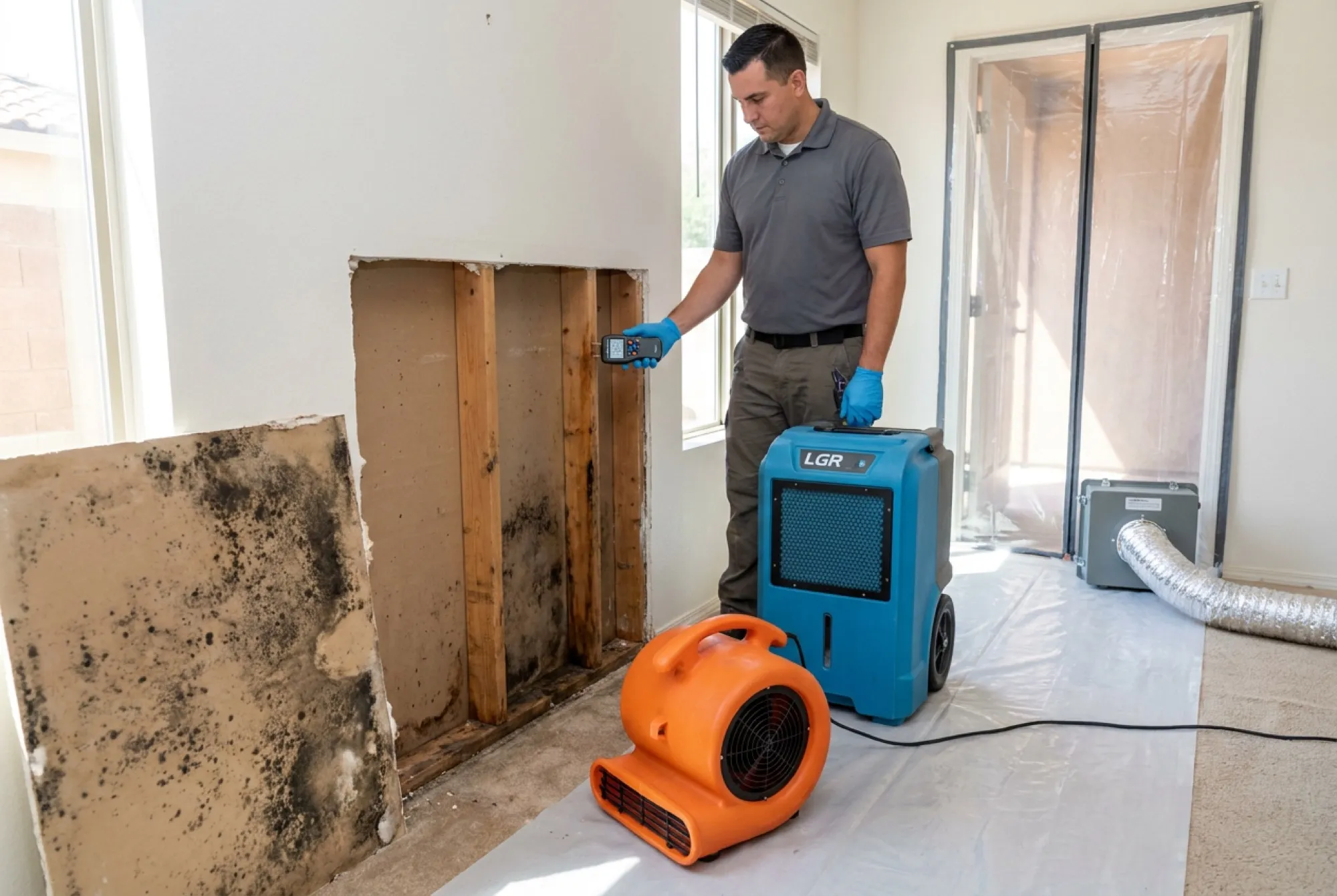
Inspection first, always. We walk the property with moisture meters and thermal imaging looking for the water source, because finding mold without finding its moisture supply is half a job. Where sampling is warranted, we take air samples (spore counts inside versus a control sample outside) and surface samples from suspect areas, and send them to an independent accredited lab.
The lab result tells you three things: whether elevated spore levels are present, what species, and how the indoor counts compare to outdoor baseline. You get the actual report — not a summary of it. And if the testing comes back clean, we tell you that and you owe us nothing for a remediation you don't need. We've walked away from plenty of inspections with "you have a ventilation problem, not a mold problem."
The Remediation Process
Removal follows containment protocols for one reason: mold removal disturbs spores, and disturbed spores travel. A crew that scrubs a wall without containment can seed the rest of your house.
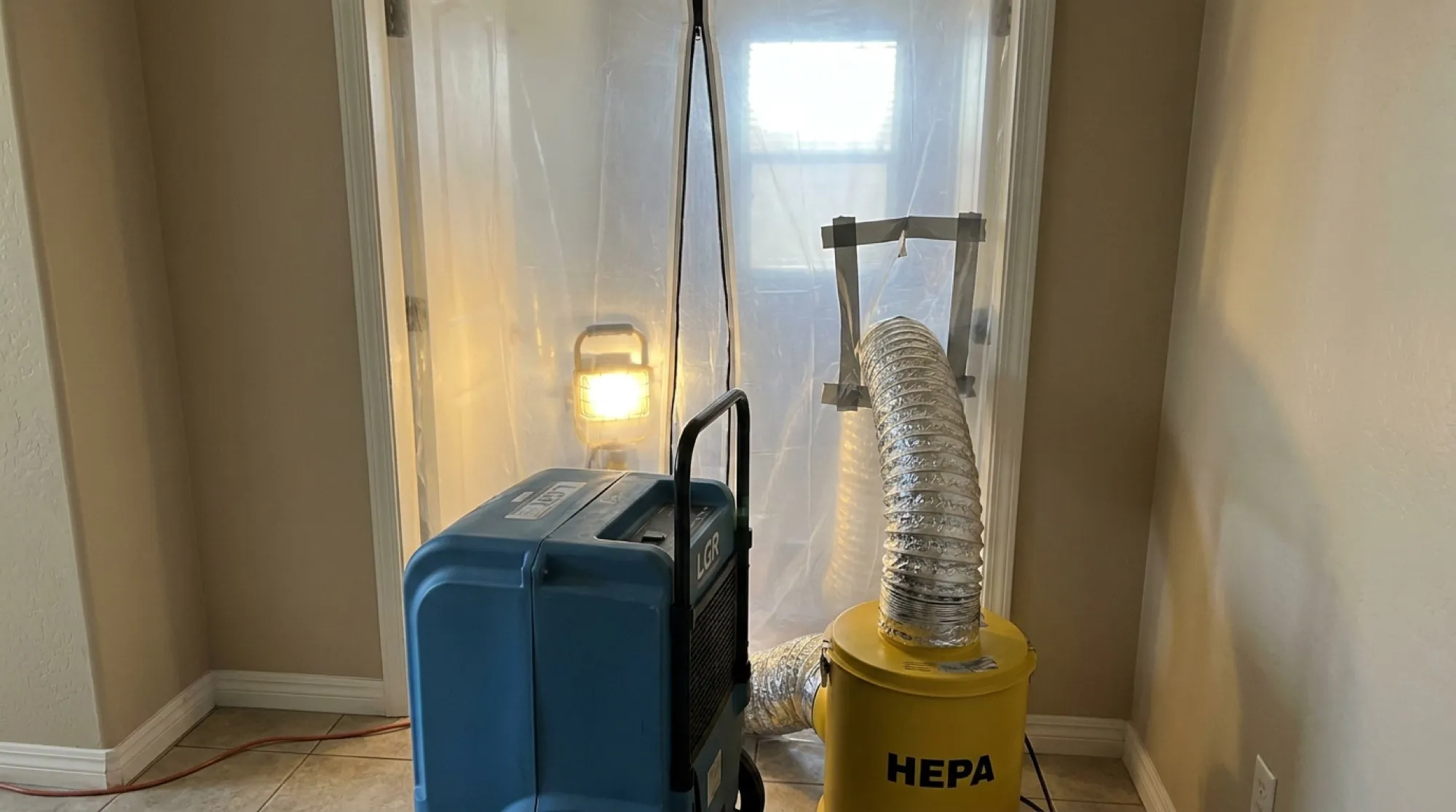
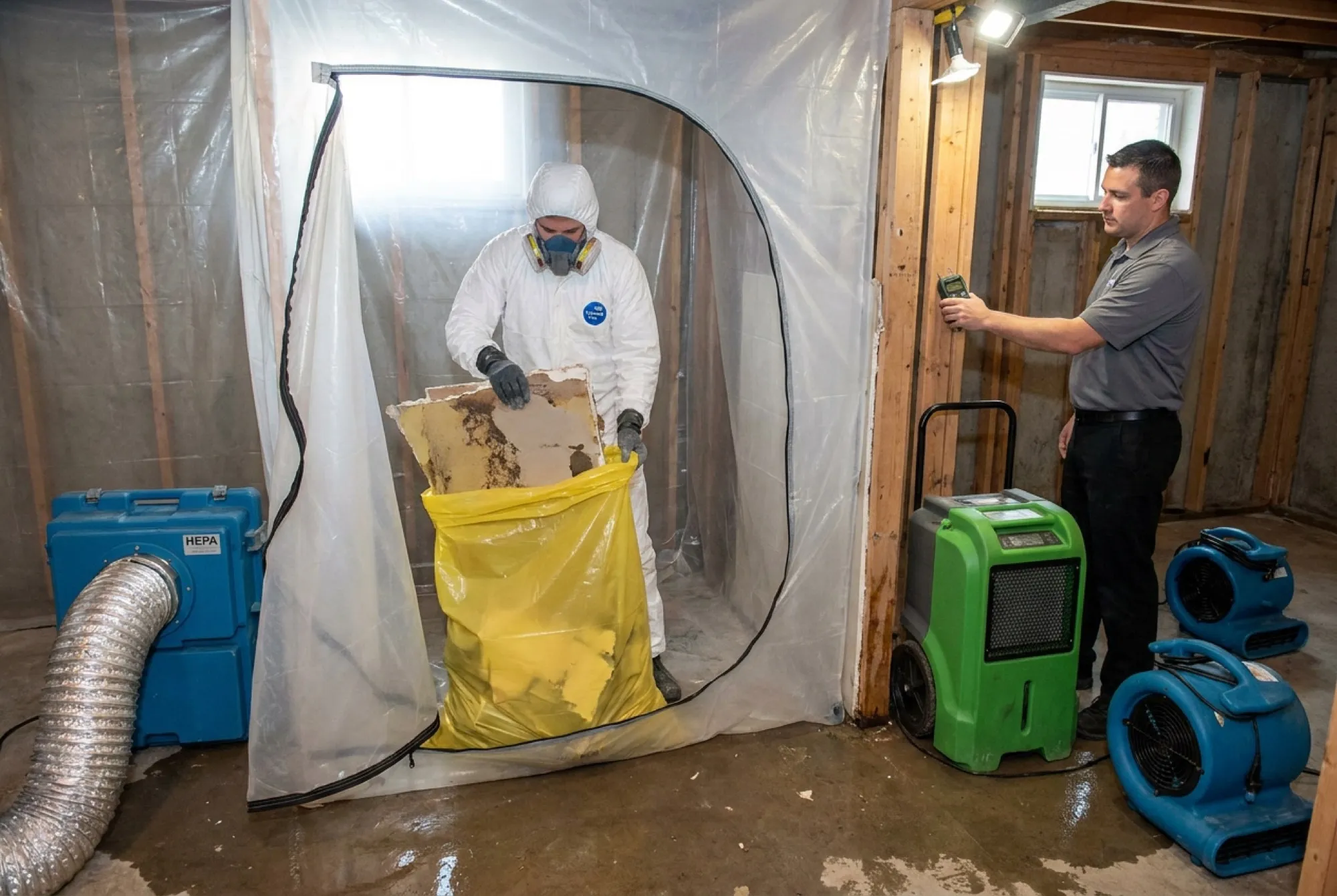
Containment goes up first — sealed plastic barriers around the work area with a zippered entry, HVAC vents in the zone sealed off so the system doesn't distribute spores. Negative air machines with HEPA filtration run inside the containment, pulling air out so any escaping air flows into the work zone rather than out of it.
Removal comes next. Porous materials that are colonized — drywall, insulation, carpet pad, particleboard — come out and get bagged inside containment. Semi-porous framing is HEPA-vacuumed, treated with antimicrobial, and in stubborn cases abrasively cleaned rather than replaced. Non-porous surfaces are cleaned and treated.
Then the air itself gets cleaned. HEPA filtration runs on the space, all surfaces in the containment are wiped down, and the equipment stays until the readings support pulling it.
For jobs where the scope warrants it, we recommend independent post-remediation verification — third-party clearance testing, so the company confirming the work is clean isn't the company that did the work. We'd rather you have that than take our word for it.
The Part Most Companies Skip
Remediation without moisture correction is a temporary result. If the slab leak still leaks, if the AC condensate line still clogs, if the bathroom fan still vents into the attic instead of outside — the mold comes back within a year, and you pay twice.
Every remediation we do starts with finding the water source and ends with it addressed. Sometimes that's our work: drying the structure, correcting a drainage problem, rebuilding with proper materials. Sometimes it's coordinating with your plumber or HVAC contractor to fix the failure at the source. Either way, the job isn't finished until the water problem is finished.
What It Costs & How Insurance Works
Pricing tracks the scope. A contained bathroom ceiling or a single vanity cavity is the small end; room-scale remediation with containment and material removal is a larger job, and whole-home or HVAC-system contamination is larger still. Testing is priced separately and honestly, because we don't want the test to be a sales tool.
Insurance is more nuanced with mold than with flood. Most Arizona policies cover mold only when it results from a covered sudden water loss — a burst pipe you reported and remediated promptly. Mold from long-term seepage, deferred maintenance, or humidity is typically excluded, and many policies carry a mold sublimit even when it's covered. We'll read the situation honestly during the inspection and tell you where you likely stand. Financing is available when insurance isn't.
Common Questions
Do I need testing, or can you just look at it?
If growth is visible and the source is obvious, testing is often unnecessary — we can scope removal directly. Testing earns its cost when the problem is hidden, when you need documentation for a claim or a real estate transaction, or when you want to confirm the job worked afterward.
Is black mold actually more dangerous?
"Black mold" usually refers to Stachybotrys, and it does produce mycotoxins. But color is a poor guide — several harmless molds are black and some problematic ones aren't. Species comes from lab results, not from looking. The remediation protocol is largely the same regardless.
Can I just spray bleach on it?
On non-porous surfaces like tile, bleach works. On drywall or wood, it doesn't — bleach is mostly water, it doesn't penetrate porous material, and the water content can feed the growth underneath while the surface looks clean. That's the most common DIY mistake we're called to fix.
How long does remediation take?
A contained bathroom job is often one day. Room-scale work with containment and drying runs three to five days. Larger scopes are scheduled at the estimate so you know before we start.
Do we have to move out?
Usually no. Containment is designed to let you live in the rest of the house. Whole-home or HVAC contamination is the exception, and we'll say so plainly rather than letting you find out mid-job.
Will mold come back after remediation?
Not if the moisture source is fixed. It always comes back if it isn't — which is why we won't do removal without addressing the water. Remediation alone is a service we decline to sell.
How fast does mold grow after water damage?
Colonization can begin in 24 to 48 hours on wet organic material. That window is why emergency response speed matters so much — fast, complete drying prevents the mold job entirely.
Can mold be inside my AC system?
Yes, and it's more common here than most homeowners expect — condensate pans and cooled ductwork stay damp. If sampling points to the system, remediation includes coordinating HVAC cleaning; sealing the house while the air handler redistributes spores accomplishes nothing.
Do you provide documentation for a real estate transaction?
Yes. Lab reports, scope of work, photos, and post-remediation verification when performed — the package buyers, sellers, and lenders ask for.
How much mold is too much to clean myself?
The EPA's line is about ten square feet — patches smaller than that, on non-porous surfaces, from a clean-water source, are reasonable DIY. Cross any of those conditions and it stops being a cleaning job: bigger than a bath mat, growing on drywall, fed by contaminated water, or anywhere near your HVAC system.
The disqualifiers matter more than the square footage. A contaminated source — sewage, storm water — makes the growth itself a biohazard. HVAC involvement means the system is distributing spores to every room it serves, and cleaning the visible patch accomplishes nothing. A smell without a visible source means the real colony is inside a cavity, and the patch you can see is the preview. And vulnerable occupants — infants, the elderly, anyone immunocompromised or with respiratory conditions — lower the DIY threshold to near zero. For the small jobs that do qualify: an N95 at minimum, gloves, damp methods only, because dry scrubbing launches exactly what you're trying to remove.
The ten-square-foot rule assumes you can see all of it. The jobs that go wrong are the ones where the patch was the preview, not the problem — which is what an inspection settles before anyone opens a wall.
What does the mold removal process actually involve?
Five steps in a fixed order: seal the area off, put the air under negative pressure, remove what's colonized, clean what stays, and verify with testing. The sealing comes first because disturbing mold launches spores — remediation without containment spreads the problem to rooms that were clean.
In plain language: plastic barriers with a zippered entry isolate the work zone, and a HEPA-filtered negative air machine exhausts air out so that any airflow moves into the containment, never out of it. Porous materials that are colonized — drywall, insulation, carpet pad — come out and get bagged inside the zone. Semi-porous framing gets HEPA-vacuumed and treated, and stubborn cases get abrasive cleaning rather than replacement. Non-porous surfaces are cleaned and wiped. Then the air itself gets scrubbed, and clearance testing — sampling compared against an outdoor baseline — confirms the numbers before the plastic comes down. A contained bathroom job is often one day; room-scale work runs three to five.
The visible mold is the easy half. The moisture source that grew it is the half that decides whether you're actually done — which is why the water gets fixed before the job closes.
Can mold grow in dry Arizona?
Yes. Mold grows on wet material, not in humid air, and the inside of a Phoenix house has plenty of wet material: AC condensate lines, slab leaks under tile, water heaters in attics, monsoon water behind stucco. Outdoor humidity has nothing to do with it.
The number that matters is 24 to 48 hours. That is how long wet drywall, carpet pad, or insulation can sit before mold starts colonizing it, and it holds in Peoria in June exactly as it does in Seattle. What the desert changes is where the water comes from. Almost none of our mold jobs start with weather. They start with a condensate drain that clogged in July, a supply line under a slab that has been seeping for months, or a fifty-gallon tank that let go in an attic while the family was out of state.
Attics are the worst of it, because the "but it's dry here" instinct is strongest about the one space nobody looks at. Sealed newer houses hold humidity that a 1960s Sun City house used to leak out through its windows. If you can smell it, or you had a leak and the cavity was never dried, have someone open it up before it spreads past the drywall.
What does it mean to encapsulate mold, and is that a real fix?
Encapsulation means sealing a surface with a specialized coating so anything remaining in the material can't release spores. It's a legitimate final step on cleaned, sound framing. It is not a substitute for removal — coat an active colony and you've hidden it, fed it, and voided the honest version of the job.
Where it belongs: structural wood that has been properly remediated but still carries staining, and crawl-space or attic framing after cleaning, using antimicrobial sealers built for the purpose — ordinary paint is food, not protection. Where it's a con: quoted as the whole job, applied over drywall (colonized drywall gets removed, never sealed), or offered with no containment and no clearance testing attached. One question exposes it every time: ask the bidder what happens before the sealer goes on. If the answer is "nothing," you're being sold a cover-up with a warranty.
Encapsulation ends a remediation. Any bid where it starts one is a bid to make the problem invisible until the next escrow inspection finds it.