Commercial Mold Remediation in Phoenix
Published August 4, 2026 · Last reviewed August 21, 2026 · Water Fighters Restoration
It usually starts with an email. A tenant reports a smell. An employee mentions headaches that clear up on weekends. Someone photographs a stain on a ceiling tile and sends it to three people, one of whom is an attorney.
From that moment, how you respond is part of the record. Commercial mold is a building problem, but it becomes a liability problem fast — and the difference between the two is documentation.
Why Commercial Mold Is a Liability Problem
In a house, mold is a health and repair issue. In a leased building, it's also a habitability question, a lease obligation, an insurance notification, and potentially a claim from someone who doesn't work for you.
Three things follow from that.
The response has to be documented from the first day. When it was reported, what was inspected, what testing showed, what was done, and what verified it. A remediation with no paper trail is indistinguishable from no remediation at all when someone asks two years later.
Independent testing matters more than in residential work. When the company doing the remediation is also the company certifying it's clean, that finding is easy to challenge. For commercial jobs we recommend third-party assessment and third-party post-remediation verification — we'd rather hand you a clearance report from a lab with no stake in the outcome.
Containment isn't optional when people are still working there. Disturbing colonized material without containment spreads spores through occupied space and turns one complaint into a dozen.
How It Starts in Valley Buildings
Commercial mold here traces to a small number of repeat causes.
Rooftop units and condensate lines. The single most common source in Phoenix commercial buildings. A clogged condensate line or failed pan drips into the ceiling cavity for weeks. It's above a drop ceiling, so nobody sees it until a tile stains or the smell reaches a workstation.
Slow supply-line leaks in walls and chases. Break room sinks, restroom risers, and janitor closets — low-visibility spaces where a weep goes unnoticed for months.
Roof and parapet intrusion during monsoon season. Flat commercial roofs, aging seams, and August storms. Water enters at the parapet and travels along the deck before it appears anywhere useful.
Water losses that were dried incompletely. A previous water event handled with fans and optimism, no moisture verification, and colonization behind the drywall that was never opened.
Chronic humidity in specific spaces. Locker rooms, kitchens, pool equipment rooms, and any space where exhaust ventilation was undersized or has failed quietly.
Assessment and Testing
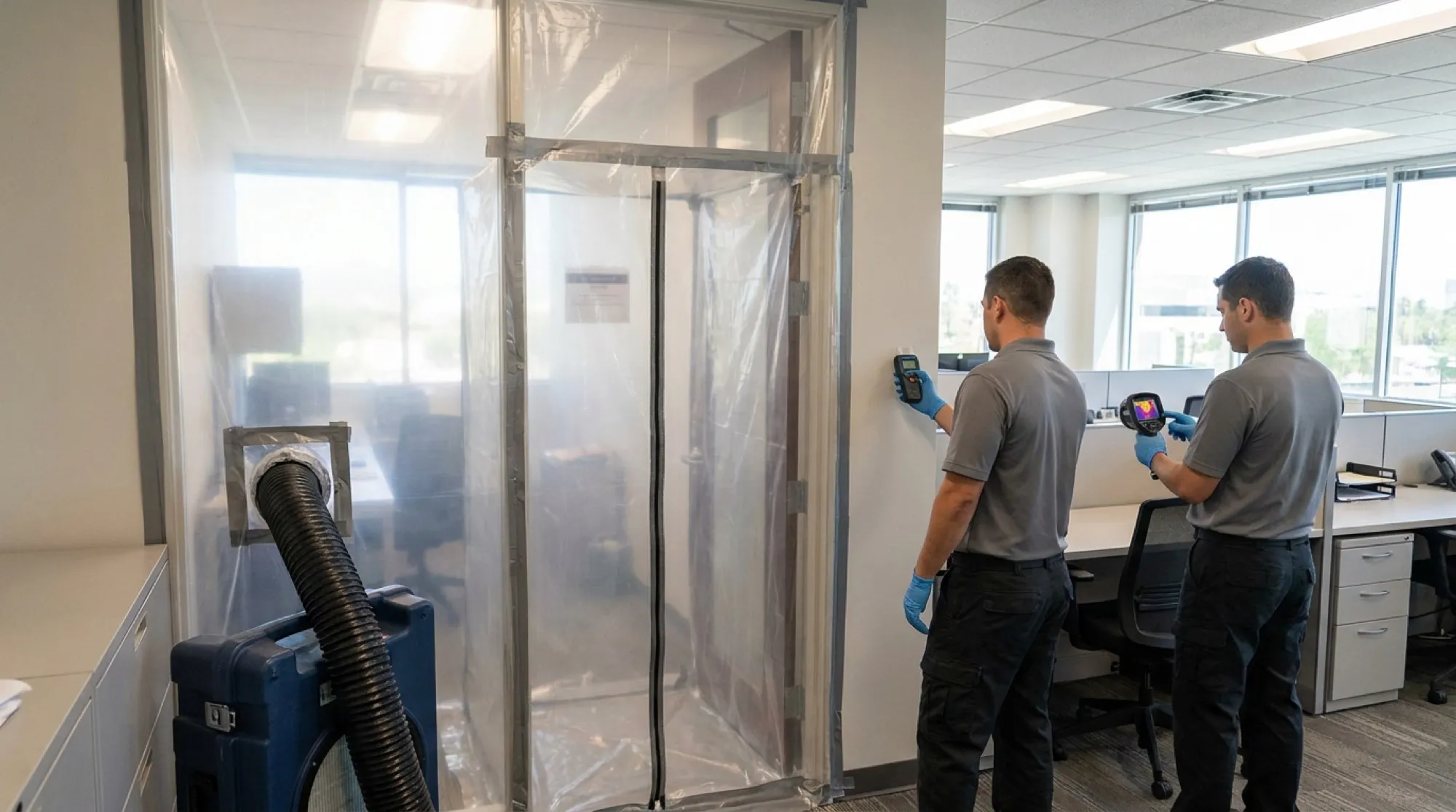
We start with the building, not the sample. Moisture meters and thermal imaging locate the water source, because remediating without finding the source guarantees a repeat.
Where sampling is warranted, air samples establish spore counts indoors against an outdoor control, and surface samples confirm what's growing on a specific material. Samples go to an independent accredited lab, and you get the full report — not our summary of it.
For larger or higher-stakes jobs, we recommend an independent indoor environmental professional write the remediation protocol and perform clearance. We'll execute to that protocol precisely. It costs a little more and it's worth it: the resulting file is defensible in a way that a single-vendor process isn't.
Containment in an Occupied Building
Most commercial jobs happen with people still in the building, which drives every logistical decision.
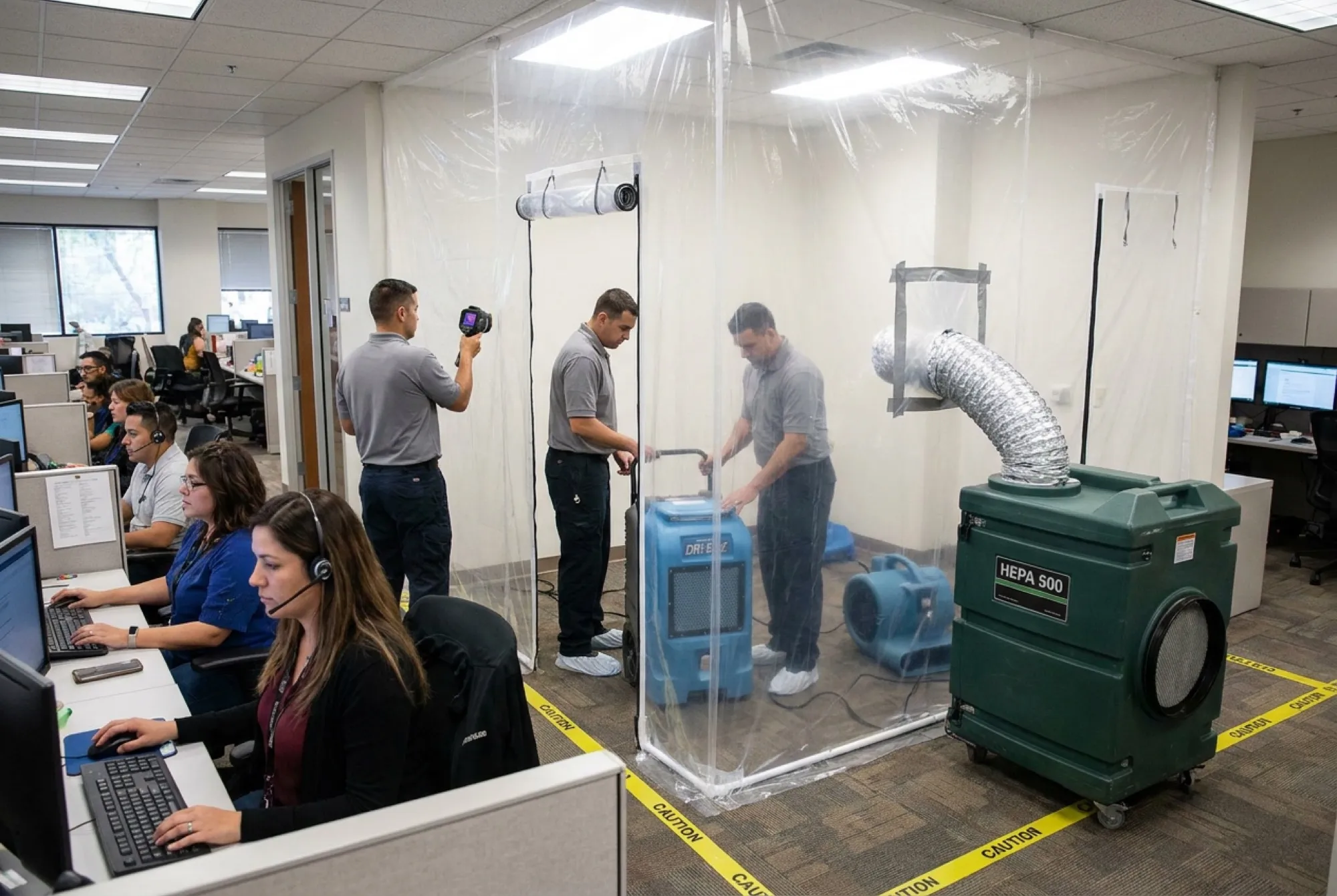
Containment barriers seal the work area, with a decontamination chamber at the entry for larger scopes. HVAC serving the zone is isolated so the system doesn't distribute spores through the rest of the floor. Negative air machines with HEPA filtration keep airflow moving into the work area, never out of it, and exhaust is routed appropriately.
Work runs after hours and overnight where occupancy requires it. Egress paths stay clear, ADA clearance is maintained, and equipment placement accounts for fire panel sensitivity — a smoke detector tripped by demolition dust is a bad afternoon for everyone.
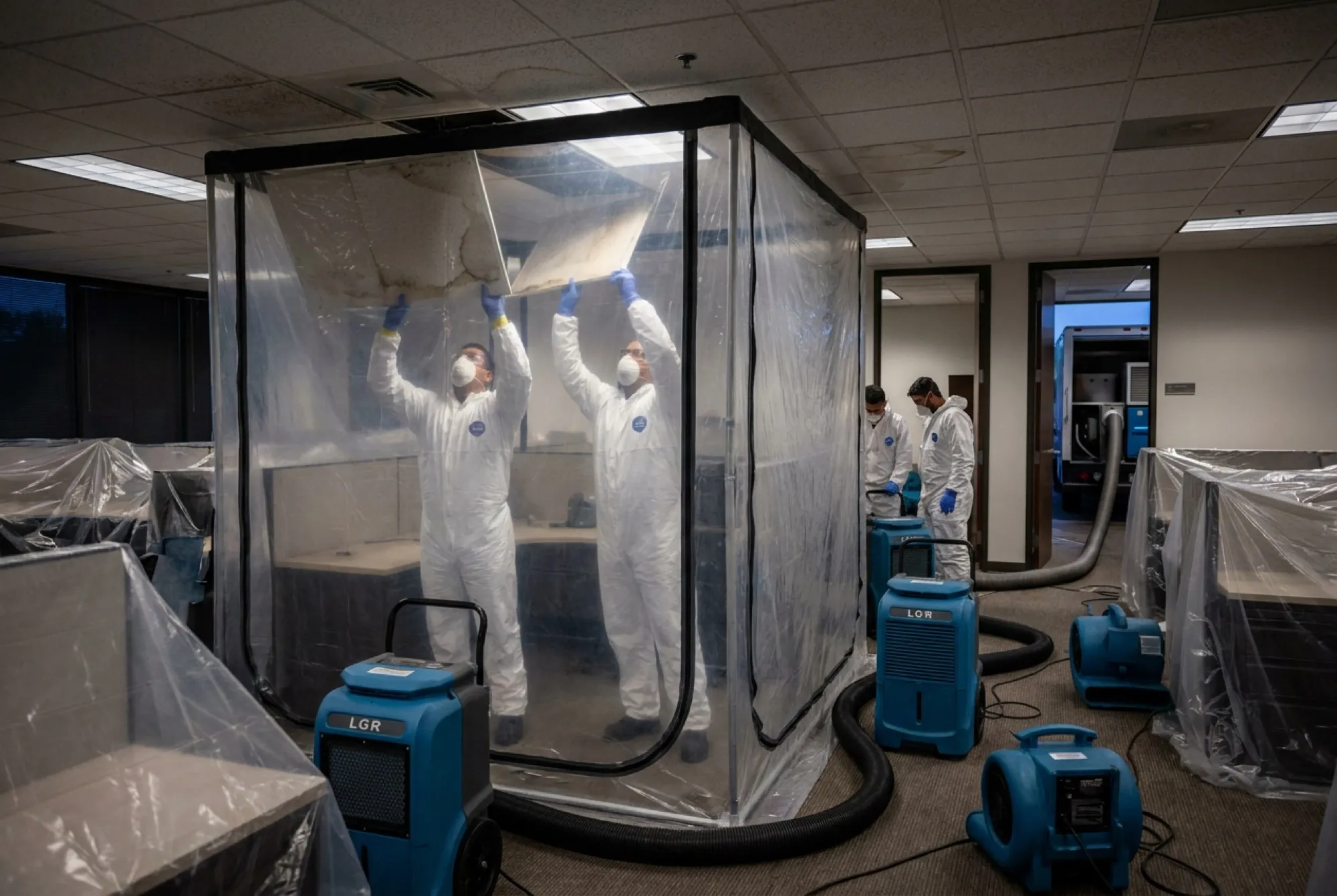
Removal follows standard protocol: colonized porous materials out and bagged inside containment, semi-porous materials HEPA-vacuumed and treated, non-porous surfaces cleaned. Ceiling tiles, insulation, and affected drywall are typically replaced rather than cleaned.
Clearance and Closing the File
The job ends with verification, then paperwork.
Post-remediation verification — visual inspection plus air sampling against outdoor baseline, performed by a third party for jobs where that's appropriate. Clearance results in writing. Then the documentation package: the original assessment, lab reports, the remediation protocol followed, daily logs, photo documentation, disposal records, and the clearance report.
That package is what you send to ownership, to your carrier, to a tenant's attorney, or to the next buyer's due-diligence team. It's the actual deliverable.
Then the moisture source gets fixed, because none of the above matters if the condensate line still drips. Where the repair falls inside our scope — drying, rebuild, affected finishes — we handle it. Where it's roofing, plumbing, or HVAC, we coordinate with your vendors and confirm completion before we call the job closed.
Coverage and Cost
Commercial mold pricing tracks scope: an isolated ceiling-cavity remediation in one suite is a contained job, while multi-suite or multi-floor work with extensive containment and after-hours labor scales well beyond it. Testing and third-party clearance are priced separately and transparently.
Coverage is where commercial policies get restrictive. Most commercial property policies exclude mold except when it results directly from a covered sudden water loss, and many carry mold sublimits well below actual remediation cost. Some ownership groups carry specific mold endorsements; many don't and don't realize it. We document everything the carrier needs and give you an honest read on where you likely stand — but the coverage conversation belongs with your broker, early.
Common Questions
Do we have to close the building or relocate tenants?
Usually no. Containment and negative air are designed specifically to let the rest of the building operate. Full relocation is reserved for extensive contamination or HVAC-system involvement, and we'd tell you that before starting, not midway.
Who should do the testing — you or an independent firm?
For small isolated jobs, our testing is sufficient and cost-effective. For anything involving tenant complaints, potential liability, or a large scope, use an independent indoor environmental professional for both the protocol and the clearance. We'll execute to their protocol. The independence is what makes the file hold up.
What are our obligations as a landlord in Arizona?
Arizona has no state mold statute setting specific remediation standards or disclosure requirements, but landlords are still bound by habitability obligations and lease terms, and mold claims are litigated under general liability principles. Document your response thoroughly and involve counsel early on tenant complaints — we're restoration contractors, not attorneys, and we'll say so.
How long does commercial remediation take?
An isolated ceiling-cavity job is often two to four days. Multi-suite work with containment, after-hours scheduling, and clearance runs one to three weeks. You get a schedule at the assessment.
Can you work nights and weekends?
Yes, and for occupied buildings it's usually how we schedule the whole job.
What if the mold is in our HVAC system?
Then remediation includes the system — coordinated duct cleaning and component treatment. Remediating the space while the air handler recirculates spores accomplishes nothing.
Will you provide documentation for our insurance and legal file?
Yes. Assessment, lab reports, protocol, daily logs, photos, disposal records, and clearance — assembled as a package.
Do you carry the insurance our building requires?
Licensed, bonded, and insured; AZ ROC 324471 and ROC 324468; IICRC certified. COIs naming your entity as additional insured, typically same day.
What if the source is a roof or plumbing issue we need to fix first?
We can remediate and coordinate around the repair, but we won't sign off on a job while the water source is active. We'll sequence with your roofer or plumber so the fix and the remediation close together.